
The mobile app ecosystem isn’t standing still. Not even for one year. By 2026, the landscape will be fundamentally changed—gone are the days when a business could get away with building a mobile app for just one platform. iOS-only? Android-only? That’s a recipe for lost users, complaints, bad reviews, and even lost revenue. Customers everywhere expect something else entirely today. They want—no, demand—a spotless experience. It must feel the same on the smallest smartphone, the shiny new tablet, a work desktop, or even smart wearables in certain sectors. A fluid journey. No hiccups. No “please switch devices” error screens.
That’s why cross-platform development has become the industry standard—not a niche advantage, but a basic expectation. Without a unified solution, businesses risk falling behind before launch. The numbers back it up: by 2026, over 70% of consumer-facing apps—and many enterprise solutions—are expected to be built on cross-platform stacks like Flutter, React Native, Xamarin, and emerging frameworks yet to peak. This shift is why more brands are turning to a cross platform app development company to move faster, cut costs, and expand reach. Savings of up to 40% compared to native builds aren’t marketing hype—they’re the new reality.
But the value runs deeper. You code once. You support every core device instantly. Developers get to design clean, maintainable logic, pushing features out simultaneously everywhere. Updates—faster. Bug fixes—quicker. Broader scalability—native performance, plus the potential for new market slices as tech evolves.
For any business leader planning to scale—not just survive—choosing a cross-platform dev partner is the first domino. The right team makes growth painless. The wrong one? Expensive technical debt, feature mismatches, headaches, and slow pivots. So let’s see the top players. Here’s your rundown of 25 global cross-platform mobile app development companies, one by one, each vetted for proven innovation, measurable business impact, and real customer success.
Top 25 Cross-Platform Mobile App Development Companies in 2026
1. Appzoro Technologies (USA)
Appzoro is a name that keeps coming up. They drive growth, not just ship apps. Their teams work quickly with Flutter, React Native, Kotlin Multiplatform—nobody pulls ahead faster. Their MVP model? Get a market-ready build in 8–12 weeks. Startups love it. Large clients do too. Besides US roots, their India team brings a perfect mix of affordable rates and experienced coders. Their culture? Blend creativity with real business sense. Appzoro doesn’t do “just features”—they work on sustainable, ROI-driven solutions. They help brands see beyond version one. That’s why their projects grow and keep users.
2. SolveIt (Poland / USA)
SolveIt’s reputation comes from sharp use of AI for smarter apps, especially those needing predictive logic. Their cross-platform dev cycles use Flutter and React Native. Agile, fast, backed by deep UI expertise. Good fit for logistics, healthcare, transport, and fitness, where business analytics really matter. SolveIt delivers a sleek design plus data-fueled insight on every screen.
3. Capital Numbers (India / USA)
Capital Numbers blends predictability with scale. They’re trusted for getting projects done at reasonable rates, without the cheap shortcuts that tank quality. React Native, Ionic—plus deep integration chops for making old systems talk with new ones. Whether working for large brands or hungry startups, their flexible contracts and build-to-suit approach stand out.
4. Andersen (Global)
Security is non-negotiable for Andersen. AR, VR, regulated sectors (health, finance, education)—they handle projects with compliance baked right into the core. Their cross-platform work stands out for robust design, solid feature planning, and post-launch reliability.
5. Xavor (USA)
Xavor wins with IoT fluency. Industries wanting to link mobile apps with smart hardware, sensors, wearables, connected devices—turn to them. Healthcare apps with device sync, smart home controls, and real-time field analytics. The company can make even complicated systems play nice together.
6. FATbit Technologies (India / USA)
FATbit’s forte is helping small businesses grow, then scale up painlessly. They build for e-commerce, service marketplaces, and appointment systems. Their cross-platform builds skip clunky transitions—features always feel seamless, animations are sharp. For budget-constrained clients who care about solid UX, FATbit delivers.
7. Appinventiv (India / USA)
Appinventiv is scale embodied. 3,000+ finished apps, everything from blockchain builds to broad consumer platforms. They live on innovation. Their teams integrate AI, ML, IoT right into the foundations—if it’s emerging, they’ll find a business fit for it.
8. GoodCore Software (UK)
GoodCore turns messy ideas into practical, clean experiences. Not just code, but deep business understanding—19+ years building for startups and SMEs. Hybrid builds with polished, intuitive interfaces. Their results feel reliable.
9. KITRUM (USA / Latin America)
KITRUM brings speed, especially for proof-of-concept or MVP cycles. Heavy use of AI and machine learning, slick cross-platform builds. Startups use them for quick launches, then long-haul scaling.
10. WEZOM (Ukraine)
WEZOM’s tested architecture and backend-first approach mean their apps integrate well with CRM, ERP, and management platforms. Strong under heavy load, lots of automation, minimal downtime.
11. Imaginary Cloud (Portugal)
Design comes first for Imaginary Cloud. Every app feels native, no matter where used—beautiful interfaces, stable cross-platform frameworks like Flutter. Their touch is visible and highly sought after for brands with design as a core value.
12. Innowise Group (Poland)
Innowise is all about enterprise integration and traceable delivery. Their teams know how to keep everything aligned: from business models, prototyping, to post-launch analytics—no step left behind.
13. Limeup (Germany)
Fintech comes naturally for Limeup. Their apps are built to handle massive transactions, secure data flows, and scale easily. If stability and speed are required, they deliver.
14. Synergy Labs (USA)
Synergy Labs specializes in MVPs and rapid prototyping. For startups trying out ideas, failing, or pivoting fast, Synergy builds structures that can grow or be reworked without an expensive rebuild.
15. Pagepro (Poland)
React Native is at the heart of Pagepro’s offering. Their builds are optimized for visuals, animations, and high performance. When polish is necessary, this team brings it.
16. ValueCoders (India)
Budget-friendly yet quality-conscious, ValueCoders does hybrid builds for SMBs, focusing on clean process, strong project documentation, and predictable costs.
17. Goji Labs (USA)
Strategy before code—Goji Labs researches user needs, industry gaps, and then codes for fit. Iteration, feedback, and usability are at the center. Their results bring strong retention and positive reviews.
18. Intellectsoft (USA)
Intellectsoft has built for Fortune 500s. Enterprise systems, secure architecture, legacy integrations, regulatory adherence—Intellectsoft’s projects don’t fail under scale or tight compliance.
19. AppMakers USA (USA)
AppMakers is known for personalized builds—custom tools, process automation, niche solutions for sectors like manufacturing, logistics, and education. Their focus is on specific business needs for each client.
20. Glorium Technologies (USA)
Telemedicine, healthcare, HIPAA-compliance. Glorium specializes in secure, privacy-first apps that scale as regulations change and medical workflows evolve.
21. Master of Code Global (USA)
Chatbots, automation, conversational interfaces—Master of Code leads smart app transformation for brands ready to modernize digital communication.
22. Closeloop Technologies (USA)
Closeloop targets B2B, complex backend systems, and scalable platforms for enterprise clients. Their projects are structured, clean, and built for growth.
23. Camber (USA)
Blending branding with tech, Camber makes sure that digital products don’t just work—they feel unified and memorable visually. For businesses needing a clear identity, this matters.
24. ELEKS (Ukraine)
ELEKS is RD-driven. Heavy use of AI, ML, and IoT in their app stack—innovation baked in from the first line of code.
25. OpenXcell (India)
OpenXcell has experience few matches. 15+ years, thousands of global projects, deep expertise in blockchain, IoT, and large hybrid systems. Clients seeking reliable delivery and value stick with OpenXcell.
Why Cross-Platform Has Won the Market
Unified codebase, single source of truth. No more duplicate files, messy sync, or weeks wasted on parallel development. When you want features on every device, you don’t wait. Launches are 50 percent faster. Updates hit every device overnight.
Budget shrinks—every business wants more for less. Cross-platform app development cost drops by up to 40 percent. Not only building, but maintenance too. When bugs show up, one patch fixes all. When users demand new features, your team can ship apps everywhere with the same code.
Quality climbs; branding stays uniform. No random issues from Android to iOS, no UX breakpoints from mobile to tablet. A single codebase means brand consistency—colors, icons, navigation, all identical everywhere. Easier learning curves, more loyalty.
Maintenance is easy. New requirements, security changes, and regulatory updates roll out everywhere with one click. Backend integrations sync smoothly. Tech talent is easier to find, as the global pool of Flutter/React Native devs keeps growing.
For companies today, cross-platform is not just smart. It’s necessary. Those who double down now lock in future security—a technical and competitive edge that lets them outpace slower rivals.
Typical Cross-Platform App Development Costs in 2026
Here’s how pricing breaks out:
Complexity matters—integrations, custom APIs, unique UI challenges, third-party systems, all shift the numbers. USA-India splits are common. US-based project management and strategy, India-based engineering teams. That ensures affordable builds with premium oversight and support.
Key Advantages Driving Adoption
Some companies move for price, some for speed, some for reach. Here’s what really shifts decisions:
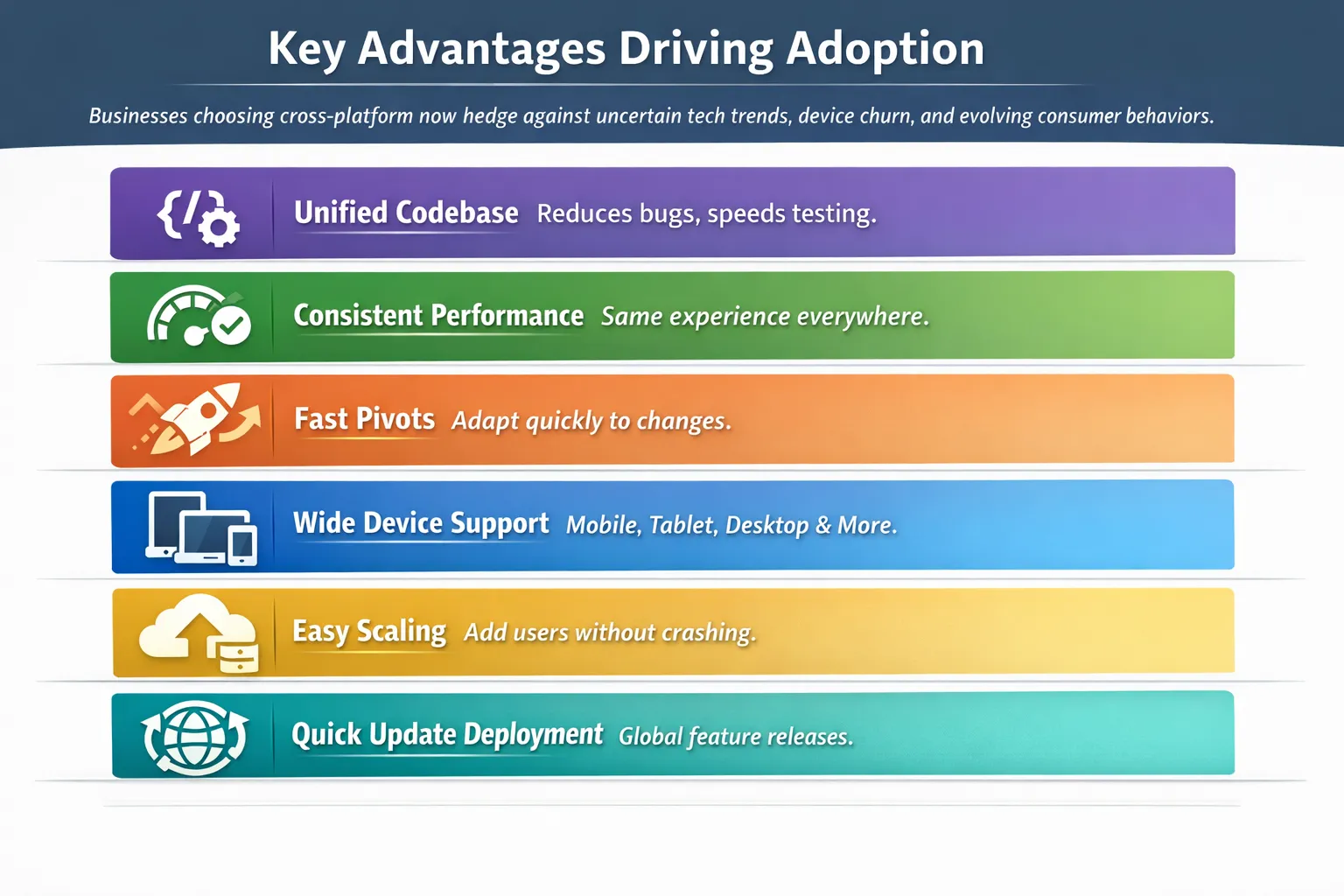
Unified codebase: Reduces bugs, speeds testing.
Consistent performance: User never sees a difference, wherever they log in.
Fast pivots: React to market, feature shifts, competitor moves without months of delay.
Wide device support: Mobile, tablet, desktop, occasionally wearables or smart screens.
Easy scaling: Add users without crashing old APIs or backend tools.
Easier access to updates: Push new features globally with one deployment.
Businesses locking into cross-platform now hedge against uncertain tech trends, device churn, and evolving consumer behaviors.

How To Choose The Right Partner? Pro Tips
Look for hybrid teams, USA/India or similar, for cost and skill balance.
Ask for MVP cycles, not just final delivery—validate ideas before going “all in.”
Prioritize firms with security, compliance, and strong backend integration stories.
Read case studies. Not just one-off successes, but long-term client relationships.
Review support options. Post-launch help, quick bug fixes, new feature sprints, and analytics dashboards.
Get pricing up front. Fixed cost models, clear estimates, and milestone tracking.
Deep Dive: Why Appzoro Stands Ahead
Appzoro’s reputation isn’t built by luck. Their hybrid team model means you get fast MVPs, enterprise integrations, and demanding system builds all handled quickly and reliably. Their US-India footprint serves both small startup launches and complex enterprise rollouts.
What else? 500+ completed projects, transparent pricing, ROI-first planning, and a support structure that goes past launch day. The engineering leadership gets involved with business strategy—so you don’t just get code, you get advice, insights, and help mapping product logic to real growth.
Clients return for upgrades, new builds, and deeper system integration—rare in an industry where churn is high.
Final Word — Ready for Scale, Ready for Speed
2026 isn’t about waiting. Mobile apps are built to perform—anywhere, anytime, on every device. Investing in old-school, device-specific tech risks delay, spiraling cost, and frustrated users.
Cross-platform mobile app development companies in this list are changing that. They make sure businesses remove frictions, move fast, spend smart, build once, and grow everywhere. The best partners do more: co-creating future-proof solutions, building brand loyalty, and keeping tech upgrades painless for years.
Start today. Reach out to Appzoro Technologies or one of these leaders. Scale smarter, not harder. The future’s already cross-platform. Don’t fall behind.
Leave a Comment