
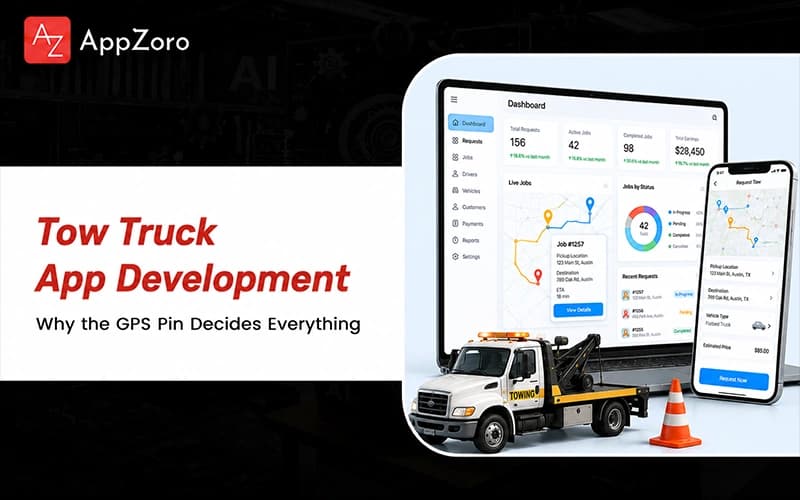
Quick Answer: Tow truck app development means building an on-demand roadside marketplace that connects a stranded driver with the nearest available tow operator. To execute this effectively, many founders partner with a specialized mobile app development company USA to ensure real-time dispatch and coordinate all three essential apps. A basic MVP starts around $30,000, while a full two-sided marketplace with high-scale functionality runs from $100,000 well into the six figures.
Picture someone broken down on a highway shoulder at night, hazard lights blinking, phone at twelve percent. That is your real user and that one scene should shape every decision in tow truck app development. They do not care about your color scheme. They care whether a truck shows up, how fast it shows up and whether the app even knows where they are.
That last part is the whole game. A roadside app that drops the pin half a mile off has failed at the only job that mattered. Before starting, you should consult a custom mobile app development guide to understand the architectural complexity of getting a real truck to a person in minutes, which is the hard part most general quotes barely mention.
So what does it take and where does the money go? Mostly into the parts nobody sees until something breaks, so here is the honest version.
What Tow Truck App Development Really Involves in 2026
Search Tow truck app development and you will get a tidy feature list, as if the work were just a booking screen and a map. It is not. Underneath sits a live dispatch system, pin-accurate location, payments that split with the operator and an emergency context where a slow or wrong answer has real consequences.
You are paying for three connected products, not one:
A customer app that nails location, lets a stranded driver request the right service and shows an honest ETA instead of a hopeful one.
A tow operator app where drivers see nearby jobs, accept the right one, navigate to the exact spot and get paid quickly.
A dispatch panel where your team assigns trucks, handles the messy edge cases, sets pricing and keeps the whole operation moving.
You Are Building Three Apps, Not One
The first surprise in tow truck app development is that one app is three connected products at once. For many startups, utilizing hybrid app development is the most cost-effective way to reach both iOS and Android users simultaneously without compromising on the live tracking features stranded customers expect. Skip a real dispatch panel and your team ends up running emergencies from a personal phone and a whiteboard.
Location and Dispatch Are the Whole Game
Connecting a stranded driver to the nearest free truck sounds simple until you try it at 2 a.m. in the rain. The system has to fix an accurate location, find trucks that are genuinely in range, weigh ETA and service type and dispatch before the customer gives up and calls a number off a billboard. Get the pin or the match wrong and someone waits alone on a shoulder, which is the one failure this product cannot afford.
On-Demand Tow Truck App Development and Why Minutes Decide Everything
This is where on-demand tow truck app development stops being a UI exercise and becomes a logistics business. Following a standardized mobile app development process ensures that you only beat the local laminated card in the glovebox with trucks that are genuinely close. A few things decide whether the marketplace can answer fast and none of them live solely on the customer's UI screen.
A few things decide whether the marketplace can answer fast and none of them live on the customer screen:
Enough operators signed up in each area, because an empty map at 2 a.m. is worse than having no app at all.
Accurate, fast location capture, since every wrong pin adds minutes a stranded person simply does not have.
Honest ETAs and live tracking, because the wait feels half as long when someone can watch the truck coming.
Liquidity of Nearby Trucks Beats Every Feature
You can add features forever. You cannot fake a network of tow trucks close enough to arrive before the customer loses patience. The platforms that win, like HONK with its 75,000-plus trucks, obsess over operator supply in each area first, which is how serious on-demand tow truck app development scales city by city instead of all at once.
Trust, Payments and Safety Are the Product
A stranger is meeting a vulnerable person on the side of a road, so trust here is the entire premise. This necessitates implementing rigorous mobile application security testing strategies to protect customer payments and verify operator identities before the truck rolls. It also means paying drivers fast, because an operator who has to fight for a payout simply stops accepting your jobs.
Tow Truck Booking App Development, Tier by Tier
So what does tow truck booking app development come to once you count all three apps and the dispatch behind them? It depends on the scope and the honest ranges are wider than the cheap numbers floating around online. Here is roughly how the tow-truck booking app development cost breaks down in 2026:
Build Tier | Rough Cost | What You Get |
Single-service MVP | $30,000–$50,000 | One city, request a tow, GPS, basic payments |
Full marketplace | $80,000–$150,000 | Customer, operator and dispatch apps, live ETA |
Custom or fleet scale | $150,000+ | Custom dispatch, motor-club integration, real scale |
Ongoing each year | 15–25% of the build | Maintenance, maps and payments upkeep, new features |
Those numbers cover the build, but they rarely include the months of recruiting operators required to fill the digital map. Reviewing a comprehensive mobile app development cost breakdown will show you that attracting enough trucks before customers arrive is often the bigger expense. Paying a fair price for a team that scopes all three apps up front is almost always cheaper by the end of year one.
Why the Cheapest Quote Costs the Most
A fifteen-thousand-dollar quote usually means one app, a basic map and none of the dispatch that makes towing actually work. The operator app, the real-time matching, the payment splits and the safety layer all surface later as costly extras. Paying a fair price for a team that scopes all three apps up front is almost always cheaper by the end of year one.
Build It Custom or Clone It and Where AI Helps
At some point, you choose between a quick roadside clone and a custom build and the answer hinges on whether you are chasing consumers or tow companies. A B2C "Uber for tows" and a B2B dispatch tool for an existing fleet are almost different products, even though both move trucks. Pick the wrong one and you end up building half of two apps instead of all of one.
AI has started to earn its place in towing but only where it shortens the wait or improves roadside safety. Learning how to use AI in mobile app development allows you to implement smarter dispatch that learns which operators actually show up and reroutes around traffic to shave a real ETA. Point it at speed and safety, not just at a chatbot sitting on the home screen:
Smarter dispatch that learns which operators actually show up and reroutes around traffic to shave a real ETA.
Predictive positioning that nudges trucks toward areas where breakdowns are likely before the calls even come in.
Safety and support, where a model handles the routine "where is my truck" questions so dispatchers focus on the hard ones.
B2C Marketplace or B2B Fleet Dispatch
The biggest fork in tow truck app development is who you actually serve, the stranded public or the tow company. A consumer marketplace lives or dies on local city supply, while enterprise mobile app development for fleet dispatch lives or dies on saving an existing operator time and money. Trying to be both at once is how budgets double and product focus quietly disappears.
Where AI Earns Its Keep on the Road
The useful AI in a towing app is boring and that is exactly why it works. It tightens dispatch so the nearest capable truck gets the job, predicts where demand will cluster and clears the routine tickets that bury small teams. Point it there, at speed and safety, not at a chatbot sitting on the home screen.
If you have a quote for a roadside app that only describes a single app, you are seeing a sliver of the tow truck app development you actually need. Our senior team reviews these proposals most weeks and we would much rather flag the missing operator app, the dispatch and the supply math now than after a stranded customer is left waiting.
Final Thoughts
Tow truck app development in 2026 is a logistics business wearing an app, not the other way around. The three apps are table stakes. The real work is accurate location, fast dispatch and enough nearby trucks to keep a promise to someone stuck on a shoulder.
The teams that win do not launch a national clone on day one. They lock down one city, sign up operators by hand, get the location and dispatch right and earn trust one rescue at a time. It sounds slow. It is also the only version that survives contact with a real breakdown.
If your quote feels suspiciously clean, you must learn how to hire the best mobile app developer who has actually shipped a dispatch marketplace and watched the supply side up close. A good partner is honest about the three apps, the operator hunt and the months it takes before the map finally fills up and order volume becomes profitable.
Leave a Comment