
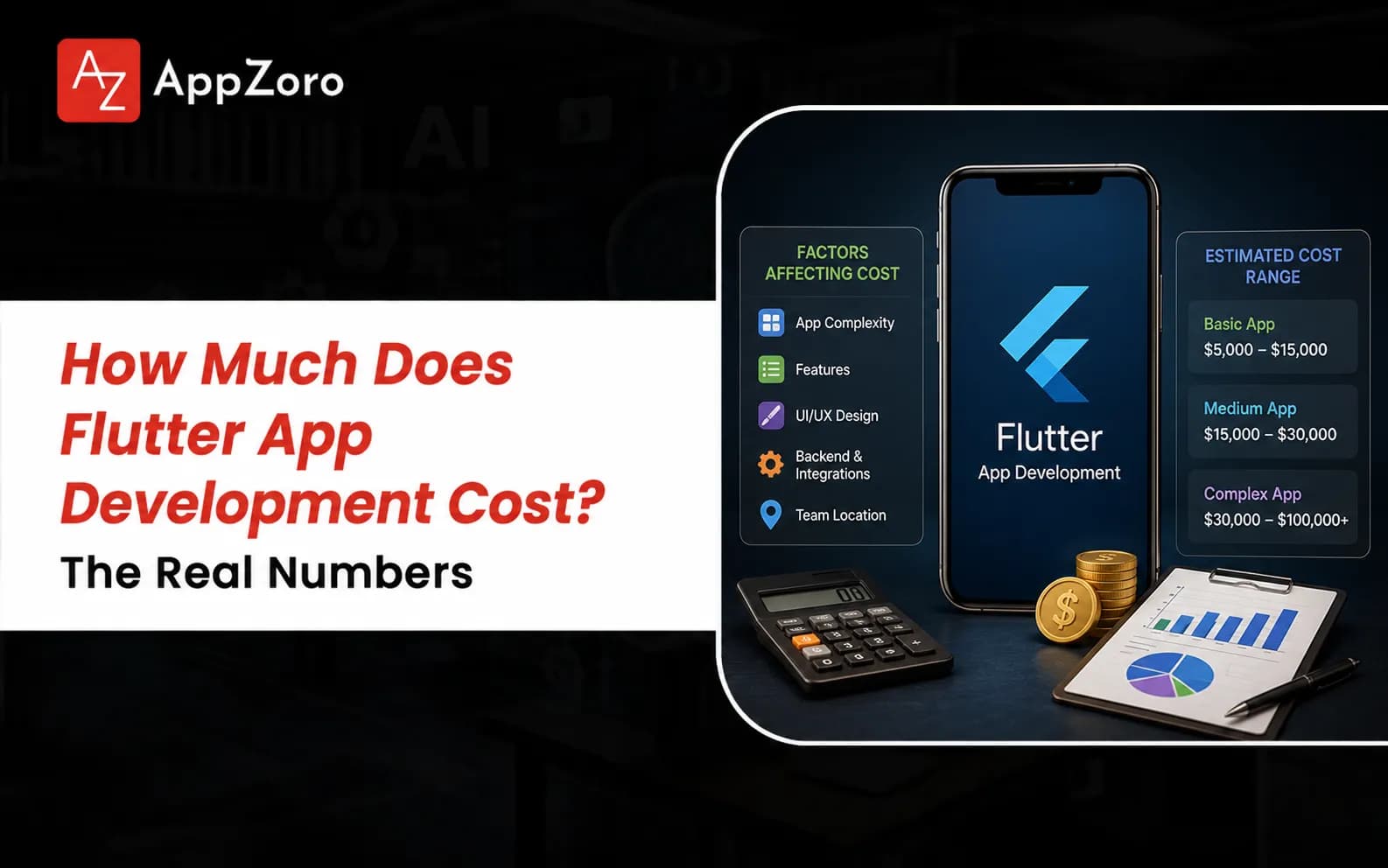
Quick Answer: Flutter app development cost in 2026 lands between $25,000 for a minimal MVP and over $300,000 for a polished cross-platform product with serious backend integration. A focused MVP covering both iOS and Android with three to five features typically runs $40,000-$80,000, while a full product lands in the $80,000-$180,000 range. The build itself is roughly thirty to forty percent of the real three-year spend, with the rest absorbed by infrastructure, maintenance and operational costs that founders consistently underestimate.
Three vendor quotes for the same Flutter app landed on a founder's desk last quarter at $32,000, $85,000 and $190,000. The spec was identical across all three proposals, the timelines landed within a month of each other and the founder spent an entire weekend trying to figure out which vendor was wrong- When the honest answer is that none of them was exactly wrong. They were measuring different things and pricing different scopes, which is part of the Flutter app development cost nobody explains until you have lived through procurement.
The 5-7x spread you see across vendor quotes is not (usually) a sign that someone is gouging you. It is a sign the category lacks shared vocabulary for what "an MVP" actually includes, what "post-launch support" actually covers and which line items get quietly omitted to make a quote look more competitive.
What follows is the cost conversation an experienced builder would have with a founder over coffee rather than the polished proposal a sales rep delivers across the procurement table.
By the end, you will know what real builds cost, why the quote spread is so wide and the hidden line items that decide whether your project comes in on budget.
What Goes Into Flutter App Development Cost in 2026
Flutter app development cost in 2026 breaks into four buckets: vendor proposals rarely separate cleanly: the engineering build, third-party integrations and native modules, QA and launch and post-launch maintenance. Most of the price spread between quotes lives in how each firm handles those buckets.
The engineering build is what most founders assume the quote covers and most of the time, the quote covers only that. Native modules for camera, payments or wearable integration sit as line items below the build, QA gets scoped tightly to happy-path coverage and maintenance is bundled into a generic retainer or punted to phase two.
Here is what the cost of Flutter app development actually breaks into:
Engineering build (Dart codebase, widget composition, state management, backend) typically accounts for forty to sixty percent of the total
Native modules, third-party integrations and platform-specific polish account for fifteen to twenty-five percent
QA, device testing and store submission account for ten to fifteen percent
Year-one maintenance, security patches and Flutter upgrades run fifteen to twenty-five percent of original build cost annually
Why the Engineering Build Is Cheaper Than Native
The engineering build itself is roughly thirty to forty percent cheaper than the equivalent native cost because one Flutter engineer ships for both iOS and Android in the time a native engineer ships for one. That advantage shows up directly in the cost of flutter app development when an honest vendor passes it through rather than padding the quote.
What Native Modules Actually Cost
Native modules: Anything touching wearables, advanced camera APIs, background location or platform sensors that sit on top of the base Flutter build and typically add $3,000 to $15,000 per module. Founders underestimate this because Flutter marketing emphasises the shared codebase advantage, while real products need three to six native modules before launch.
Why QA Gets Quietly Underscoped
QA gets quietly underscoped because the line item is hard to defend against a competitor pricing it at half the rate. Cheap QA looks like one round of testing on two devices; serious QA covers at least eight device profiles, accessibility validation and the edge-case work that catches the regressions Apple's reviewers find anyway.
How Much Does Flutter App Development Cost: The Real Numbers
When founders ask how much Flutter app development costs, the realistic 2026 answer depends heavily on what tier of build you need. A minimum viable product validating a hypothesis with a small audience costs meaningfully less than a polished cross-platform product with serious backend integration.
The number founders quote at conferences ($50K-$150K range) is roughly accurate for the middle tier but understanding which tier your product fits is what determines whether procurement feels coherent or chaotic:
A minimal MVP with two to three core features and basic backend lands between $25,000 and $50,000
A focused MVP covering both platforms with three to five features and proper polish lands between $40,000 and $80,000
A full Flutter product with rich features and integrations lands between $80,000 and $180,000 depending on scope
A premium product with native modules, video, AI features or deep backend integration lands between $150,000 and $300,000
What a $50,000 Flutter Build Actually Gets You
A $50,000 Flutter build buys you a focused MVP with three to four well-scoped features, a clean visual design, basic backend integration and a stripped-down admin panel. What it does not buy is comprehensive QA, native modules beyond the basics or post-launch maintenance.
When the $150,000+ Tier Is Justified
The $150,000+ tier is justified when your product needs native modules across multiple features, deep backend integration with payment processors and analytics, intensive QA across many device profiles and proper post-launch support. Skipping any of those at this tier is how teams end up rebuilding parts of the product eighteen months later.
Why Vendor Quotes Span 5-7x for the Same Spec
Vendor quotes span 5-7x for the same spec because each vendor silently scopes different things behind the headline number. The $32K quote usually skips QA, native modules and post-launch support; the $190K quote bundles all three plus six months of maintenance. Reading line items is what separates founders who navigate procurement from founders who get burned.

Estimating Flutter App Development Cost: The Process That Works
Estimating flutter app development cost honestly requires two to three weeks of structured discovery before any vendor commits to a binding number. The number you get without discovery is a guess dressed up in a proposal template, which is how procurement spreadsheets end up with quotes that look comparable but price entirely different scopes underneath.
The strongest founders I have watched force their vendors through structured discovery before locking in pricing. A two-week discovery phase costing $5,000-$15,000 routinely saves $30,000-$100,000 in rework and the painful "phase two" change orders that hit around month four.
Here is the estimating process that works in 2026:
Spend two to three weeks on structured discovery before requesting binding quotes - feature audits, user flow mapping, integration inventory
Force vendors to itemise proposals across engineering, native modules, QA, store submission and post-launch maintenance separately
Add a 15-25% contingency line item to your internal budget for inevitable scope additions during execution
Why Discovery Is the Cheapest Investment You Make
Discovery is the cheapest investment you will make because two weeks of structured exploration prevents four months of painful rework once your vendor realises the spec was incomplete. Founders who skip discovery to save $10,000 routinely spend $40,000-$80,000 on change orders - a pattern I have watched repeat across three projects since 2024.
How to Force Honest Line Item Comparisons
Forcing honest line item comparisons means sending vendor candidates a structured RFP template listing each cost bucket separately, rather than accepting their preferred "one big number" pricing. Honest vendors appreciate the discipline; dishonest vendors hate it because it exposes the gaps.
Why a 15-25% Contingency Is Non-Negotiable
A 15-25% contingency is non-negotiable because scope creep is structural in software, not a sign of poor planning. Building it into your initial budget means inevitable additions land as expected business decisions rather than panicked CFO conversations.
Hidden Costs of Flutter App Development Most Founders Miss
The hidden Flutter app development costs that consistently surprise first-time founders cluster around three categories: native modules nobody scoped during discovery, post-launch maintenance quietly punted to phase two and third-party API fees that scale with usage.
The annoying part is that none of these are hidden by malicious vendors. They are hidden by how the category prices itself, which assumes the founder will negotiate them as separate line items rather than expecting them to be bundled into the headline cost:
Native modules for wearables, advanced camera APIs or background location add $3,000-$15,000 per module beyond the base build
Third-party API fees (Mapbox, Twilio SMS, Stripe, OneSignal push) typically add $200-$5,000 monthly depending on user volume
Apple App Store and Google Play take fifteen to thirty percent of in-app purchase revenue, which compounds quickly at scale
The Native Module Surprise
The native module surprise hits around month two when the engineering lead realises the wearable companion feature, advanced camera scanning or background location tracking all need custom native modules never in the base scope. Budget $15,000-$50,000 upfront rather than treating them as change orders.
API Fees That Quietly Scale
API fees that quietly scale are the operational line item that founders underestimate most. Mapbox at scale, Twilio SMS for verification, Stripe transaction fees and push notification services add up to thousands per month once your user base crosses any meaningful threshold — money that was not in the original quote.
Why Maintenance Is Cheaper to Budget Than to Discover
Maintenance is cheaper to budget than to discover because year-one fixes, framework upgrades, security patches and dependency updates happen whether you planned for them or not. Budgeting twenty percent of original build cost annually from kickoff means these expenses land as expected, rather than as the painful CFO conversation.
What Senior Teams Quietly Get Right About Flutter App Development Costs
The strongest founders I have watched navigate Flutter procurement share disciplines that land them at honest pricing without the painful surprises that define first-time projects. They win because they understood the structure of Flutter app development costs before the proposals landed on their desk.
Here is what senior founders do differently when approaching the cost of Flutter app development:
They invest in structured discovery before requesting binding quotes, which lets them compare proposals on equivalent scope
They force vendors to itemise line items separately rather than accepting one headline number
They budget 15-25% contingency from kickoff, which means scope additions land as expected business decisions
Why Structured Discovery Pays for Itself 5x Over
Structured discovery pays for itself 5x over because the $5,000-$15,000 spent upfront prevents the $50,000-$100,000 in change orders that hit founders who skip it. The math is consistent enough to call it a structural feature of the category.
How Honest Itemisation Filters Vendor Quality
Honest itemisation filters vendor quality because vendors who refuse to break out line items are usually hiding scope gaps they do not want to defend during execution. Vendors who embrace itemisation deliver cleanly when you sign- exactly the signal procurement teams need.
Why Budgeting Contingency Is a Sign of Maturity
Budgeting 15-25% contingency from kickoff is a sign of mature project management, not pessimism. Scope creep is structural in software and founders who budget for it land projects on time and on budget while founders who do not end up rebuilding parts they could have scoped right the first time.
If you have a stack of vendor quotes for a Flutter build sitting on your desk and want a no-pitch second opinion on what is actually scoped versus quietly omitted, our senior team reviews these proposals for founders almost every week. Happy to flag anything underscoped before you sign.
Final Thoughts
Flutter app development cost in 2026 is more legible than three years ago but only if you bring structured discovery, honest itemisation and proper contingency into procurement.
The 5-7x quote spread is real but explainable and the founders who navigate it successfully read the line items rather than chasing the lowest headline number.
If the proposals on your desk feel impossible to compare honestly, get a second opinion from someone who has actually shipped Flutter products to real users. The right partner walks you through the line items without flinching, because they have lived inside enough builds to know where the costs land.
Leave a Comment